|
|
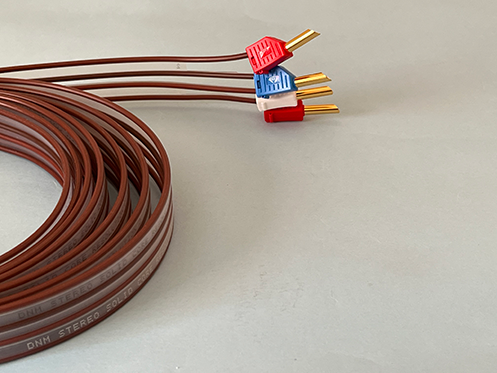
This product includes everything except postage and packing charges - the
selected length of stereo cable, the plugs and the plug fitting, are all
included in the price.
Seven reasons why you should buy ready-made DNM cables direct from DNM
Design :
1. DNM invented these cables, so we know the best way to build them.
2. We use non-mechanical cable preparation to protect the soft copper solid core conductors.
3. DNM can customise the cable for your system and offer system advice.
4. DNM offer the ideal connecting plugs.
5. Cable strain relief is built into DNM-built interconnect cables.
6. Balanced XLR cables need a special cable build, developed by DNM.
7. Only DNM can build HFTN interconnect cables.
Just choose the cable length below "Length in metres".
Then choose your required plugs from the
"Plugs at amplifier end of the cable" list
and the
"Plugs at speaker end the of the cable" list
The minimum stereo length that can be ordered is 0.5 metres for interconnect
and 1 metre for speaker cables.
|
 30% OFF SALE!
Electrolytic capacitors use Aluminium foil plates arranged in large area coiled strips which are prone to induced eddy currents in their conducting area. Eddy currents prevent capacitors from working optimally in audio amplifiers, significantly degrading sound quality.
By introducing carefully positioned fine slits in the Aluminium foil, the eddy currents are controlled, improving the performance of these DNM-designed capacitors (both the Slit foil and the T-Network range).
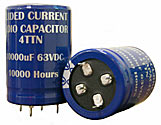
DNM T-Network 4TTN Capacitors
Instead of the simple two terminals, one positive and one negative, found on most capacitors, the DNM Designed T-Network capacitor has two input terminals and two output terminals.
Each terminal is connected to a different place on each capacitor plate winding, one to the centre and the other to the two ends.
This unique connection arrangement guides the capacitor current along a controlled path which greatly reduces the adverse effect of unwanted plate resistance and inductance.
The result is a massive improvement in capacitor performance, with typically 11dB more effective filtering extending to frequencies 30 times higher than a two terminal capacitor.
The T Network 4TTN Capacitor is probably the best audio electrolytic made today.
|
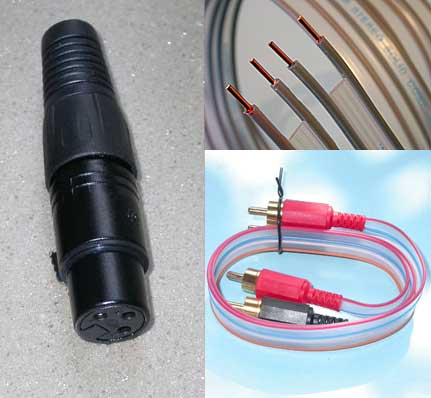 Ordering from Cable Components (CC) enables a much wider variety of complete cables and also separate components to be ordered.
For example it is possible to order from 1) only cable
or from 2) only plugs.
From these two Cable Component sections it is easy to order cables and/or plugs as separate items.
By adding 3) the DNM Cable Building Service, you can order a complete Ready to Use cable - the range of cables lengths and plug types is much greater than in the Ready to Use cable section.
Seven reasons why you should buy DNM cables direct from DNM Design
1. DNM invented these cables, so we know the best way to handle them.
2. DNM provide detailed cable preparation information.
3. DNM can suggest cable build methods to suit your system and offer system advice.
4. DNM offer the ideal connecting plugs.
5. Cable routing advice is available from DNM.
6. Balanced XLR cables need a special cable build, advice is available from DNM.
7. Only DNM can offer in-cable HFTN filters and plug-in speaker cable HFTNs.
|
PRODUCT ANNOUNCEMENT
THE DNM HIGH FREQUENCY TERMINATION NETWORK (HFTN)
is a new type of cable-related product that reveals the full audio potential of DNM interconnect cable.
The HFTN improves clarity by controlling ultra-high frequency reflections within the cable, reducing digital glare and enhancing tonal purity. DNM interconnect with HFTNs can outperform the highest priced interconnect cables.
Now available in our online shop:-
A dedicated HFTN is available to suit each of the three (RCA) phono plug types and the DNM DIN plug.
A DNM stereo interconnect cable fitted with HFTNs can be ordered as follows:-
First - choose your DNM-made cable. Purchase :
1. the required length of cable,
2. the chosen plugs,
3. the plug fitting service (one per stereo length).
Now, to add HFTNs to this cable, purchase :
4. 4 HFTNs (the quantity needed for each stereo length) of the type for your chosen plugs and
5. 4 HFTN fitting services (one for each HFTN).
|
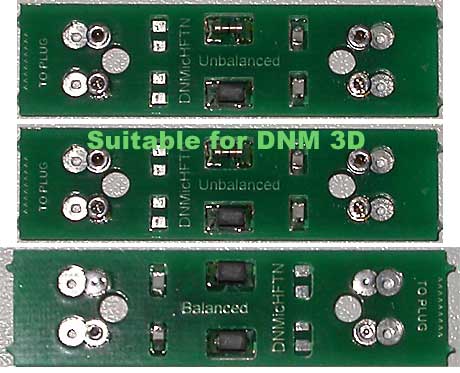
The In-Cable HFTN can be soldered into existing DNM cables at home if you have soldered cables before - you only pay for the HFTNs now.
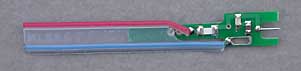
Each In-Cable HFTN is just 48mm long by 13mm wide and only two wires need to be soldered on at each end of the In-Cable HFTN.
THE IN-CABLE DNM HIGH FREQUENCY TERMINATION NETWORK (HFTN)
is a new type of cable-related product that better reveals the audio potential of DNM interconnect cable.
The HFTN improves clarity by controlling ultra-high frequency reflections within the cable, reducing digital glare and enhancing tonal purity. DNM interconnect with HFTNs can outperform the highest priced interconnect cables.
The DNM HFTN solution
DNM research has shown that it is possible to minimise this reflection problem by controlling the RF termination of the cable so that it will interact far less.
As a result we have developed a production version of the RF termination system.
Named a "High Frequency Termination Network" (HFTN), it is a precision circuit that almost eliminates RF load variation in DNM cables whilst remaining transparent to audio signal.
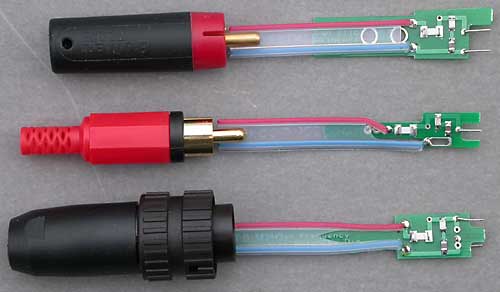
HFTNs are available on micro-PCBs small enough to fit inside interconnect plugs and soon DNM will release another version that will fit onto the ends of DNM speaker cable. The HFTN can be added to existing DNM cables or ordered with new DNM cables.
With HFTNs the performance of the amplifier/cable system is significantly improved, resulting in a surprising increase in audio clarity.
Now available in our online shop:-
A dedicated In-Cable HFTN is available to suit unbalanced cables (phono or DIN plugs) or balanced cables (XLR plugs).
There is also a version of the unbalanced In-Cable HFTN made just to suit the DNM 3D preamplifier.
To order In-Cable HFTNs for an existing cable, just order four In-Cable HFTNs for each stereo cable.
You can also add In-Cable HFTNs to new DNM-built cables if you wish. If you do wish to do this, please order
1. the required length of cable,
2. the chosen plugs,
3. the plug fitting service (one per stereo length).
Now, to add HFTNs to this cable, purchase :
4. Four In-Cable HFTNs (the quantity needed for each stereo length) of the type for your chosen plugs and
5. Four In-Cable HFTN fitting services (one for each In-Cable HFTN).
|
Each HFTN requires precision fitting into the selected audio plug.
To order a DNM stereo interconnect cable ready-built and fitted with HFTNs, after choosing the type of plugs and the cable, then order the HFTNs and finally use this section to order one HFTN fitting service for each HFTN.
For example, one stereo length of DNM interconnect cable fitted with 4 HFTNs needs 4 HFTN fitting services to be added to the order.
|
 PRODUCT ANNOUNCEMENT
The DNM ZERO REFLECTION TERMINATION NETWORK (ZRTN)
- a cable-related product for use with DNM stereo speaker cables that reveals their full audio potential. Significant improvements will be gained in systems with amplifiers that use negative feedback.
The ZRTN eliminates ultra-high frequency reflections within the speaker cable, improving the stereo image, reducing digital glare and enhancing tonal purity.
DNM ZRTNs - for DIY fitting
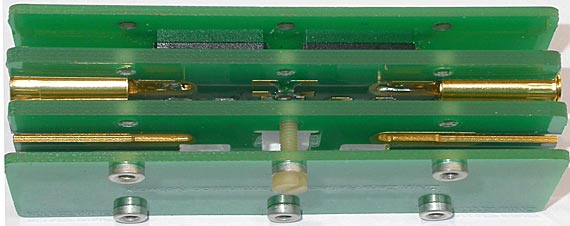
NEW - the ZRTNs simply plug into the amplifier outputs and your existing DNM SPEAKER cables plug into the ZRTNs, so that the signal flows through the ZRTNs. The ZRTN is a series/parallel device and it is significantly more effective than the parallel HFTN for speaker cable.
- please see the data sheet link on the product's page which illustrates the way to connect ZRTNs with your DNM speaker cables. -- Full ZRTN fitting and connection information.
Each ZRTN measures 29mm high by 85mm wide.
Background
Audio cables are intended to work in the audible frequency range from 20Hz to 20,000Hz. At the low end, cables transmit energy down to direct current and at the highest frequencies some signal sources extend up to 100,000Hz.
1) the units used to measure high frequencies are kiloHertz (kHz) for thousands of Hertz
(1 Hertz = 1 cycle per second) and MegaHertz (MHz) for millions of Hertz.
2) the term 'amplifier' applies not only to the power amplifier driving the speakers, but to all the amplifiers used in the audio chain, including the pre-amplifier, the output amplifiers in the CD player, D-to-A converter, radio tuner, MP3 player etc.
The problem
When an audio cable is connected to an amplifier it interacts with a range of frequencies that are much higher than anticipated. The cable is exposed to radio frequencies (RF) that extend above 100MHz and this unexpected energy is injected into the cable by the feedback system in the amplifier.
Feedback is used in almost every amplifier to define gain and reduce distortion. It is generally thought that it improves amplifier performance without adversely affecting sound quality. However, because feedback action occurs at very high frequencies, any RF non-linearity in the amplifier can interact with the cable and cause degradation of the audio signal.
This interaction is a primary cause of the differences heard in audio cables.
One easily measured consequence is severe load dips in the cable impedance, as seen by the amplifier, down to just a few Ohms at multiple points across the RF range. The uneven RF loading occurs in interconnect and speaker cables and it significantly degrades amplifier performance, resulting in glare and loss of clarity.
The DNM solution
DNM research has shown that it is possible to minimise this problem by controlling the RF termination of the cable so that it will not interact.
(In the valve amplifier heyday, impedance matched connections were widely used mainly to avoid signal loss, but in modern hi-fi this discipline seems to have been forgotten)
As a result we have developed a production version of an RF termination system to work with DNM Stereo speaker cables named a Zero Reflection Termination Network (ZRTN). The ZRTN is a precision circuit that eliminates radio frequency (RF) reflection in DNM cables whilst remaining transparent to audio signal.
The ZRTN can be added to existing DNM speaker cables or ordered with new DNM speaker cables.
With ZRTNs the performance of the amplifier/cable system is significantly improved, resulting in a big increase in audio clarity.
To order ZRTNs for an existing DNM cable, order 1 pair of ZRTNs for each stereo cable or, in the case of an amplifier with balanced outputs, order 2 pairs of ZRTNs.
You can also order ZRTNs with new DNM-built cables. To do this, please order a ready-made DNM speaker cable fitted with plugs or a custom-made order as listed below:-
1. the required length of cable,
2. the chosen plugs for the cable,
3. the plug fitting service (one per stereo length).
Then to add ZRTNs to this purchase :-
4. Add 1 pair of ZRTNs (the quantity needed for each stereo length)
5. If you are using 2mm plugs at the amplifier end of your DNM speaker cables (for example to plug into a DNM PA3 power amplifier) order one pack (4 pieces) of 2mm-to-4mm adaptors so that your cables can be plugged straight into the 4mm sockets in the ZRTNs. NB. there are two types of 2mm-to-4mm adaptors, please read the information about these.
ALSO you can request that ZRTNs can be supplied with short links/plugs made of DNM cable that are soldered into the amplifier end of the ZRTN - just order 1 pair of links with the correct type of plugs to fit your amplifier. e.g. 2mm or 4mm plugs, or spade terminals or bare wire.
|
Visit Simona Morecroft’s web page to hear and buy her song for the NHS.
|
|