Solid Core Cables
On this
Page : Overview Eddy Currents Connectors
NEW DNM Stereo Solid Core Resolution 2 speaker cable

(see below)
Ready-Made DNM Cables are available, just select your type and the length
Why buy your cables made by DNM?
- DNM invented these cables, so we know the best way to build them
- We use non-mechanical cable preparation to protect the soft copper solid core conductors
- DNM can customise the cable for your system and offer system advice
- DNM offer the ideal connecting plugs
- Cable strain relief is built into DNM-built interconnect cables
- Balanced XLR cables need a special cable build, developed by DNM
- Only DNM can build HFTN interconnect cables.
See more in the DNM Online Shop here.
Overview of DNM Stereo Cables
In 1984 DNM made the first spaced-pair single solid core audio cables which over time became recognised for their
unique clarity of sound. They were designed to give improved magnetic performance and good amplifier loading, factors which have
been neglected by other cable makers. Low cost and high performance ensured the commercial success of DNM cables for over 23 years.
In 2007 DNM cable research moved on : driven by the demands of our amplifier technology,
we announced Stereo Solid Core Precision audio cable using a unique design of ribbon to enhance
performance and ease of use.
Now in 2026 we have progressed again to two new even higher performance speaker cables, a replacement for Precision called DNM Precision 3
and a replacement for the heavier DNM stereo speaker cable called DNM Resolution 2.
Full Resolution 2 announcement details here.
DNM Stereo Solid Core cable is designed to enable any amplifier driving the cable to work optimally
into the cable load. Ultra high frequency interactions between the amplifier and cable play a major part
in determining the sound quality of the combination, but observed differences in sound are normally
attributed to the cable alone.
The design of the insulated casing (the ribbon) plays an important part in the sound quality of DNM Stereo cables for reasons shown in this
link How DNM Stereo Solid Core cable works.
One key aim of the new DNM Stereo cable design was to make the preparation and termination of the cable much easier,
so that customers could choose to fit the connectors themselves and save money. Our
DNM online shop sells cables
and connectors and also offers a construction service for customers who prefer to purchase complete ready-to-use cables.
This link gives detailed information
with illustrations about Preparation/Assembly of DNM stereo cables and Directionality.
Since 2008 the DNM range of stereo solid core cables has been extended to three types, two stereo/bi-wire speaker cables and
one stereo interconnect cable, offering an ideal cable for most applications with the clearest sound regardless of price.
- NEW : DNM Stereo Solid Core Precision 3 speaker cable - is a compact
(see dimensions)
dual channel ultra-high resolution cable intended for
use in smaller audio systems with higher sensitivity speakers (over 89dB/W). More Information
- NEW : DNM Stereo Solid Core Resolution 2 Speaker cable
(see dimensions)
Designed for use with normal-to-low sensitivity loudspeakers DNM Resolution 2 improves on the audio performance of DNM Precision 2
but it can be used with larger audio systems,
longer cable runs, speaker sensitivity below 89dB/watt and more powerful amplifiers.
The ribbon dimensions are set to reduce the capacitance and slightly increase the inductance, to ensure amplifier stability with longer runs of cable.
The result is a stereo ribbon 22.4mm wide and 2.4mm thick with the same facility for easy installation as the Precision cable but with a
much higher performance when using medium to low sensitivity speaker systems.
The DNM Resolution 2 ribbon contains four 1.2mm diameter high purity copper conductors. A single length of DNM Resolution 2 connects two stereo speakers or one bi-wired speaker.
Easy-separation lines in the ribbon make cable preparation very easy.
The unique design of the DNM ribbon places the conductors above the ribbon's centre-line to project the magnetic field through air rather than insulation material.
The cable's structural Q is low because the easy-separation lines also reduce the ribbon's stiffness.
Visually DNM Resolution 2 is equally advanced, with a semi-transparent outer ribbon and coloured insulation on the conductors
but a third layer of brown insulation makes the ribbon appear light brown and it blends into the background in the room. The insulation colours are visible but only when needed
- as the insulation is stripped.
The electrical parameters of DNM Resolution 2, its capacitance, inductance and resistance, are aligned to improve the driving amplifier's stability and sound quality.
The characteristic impedance of DNM Resolution 2 is accurately matched to our optional high frequency termination networks (HFTN's and ZRTN’s).
HFTN filters greatly improve performance when the cable is connected to amplifiers using negative feedback. They can be added at each end of the cable when the ultimate audio performance is required.
The recommended way of using the new DNM Stereo Solid Core Speaker cables is as follows :-
The cable directionality can be determined by noting that the print runs in the same direction as the signal.
At the amplifier end separate the cable just enough to allow the plugs to be fitted and plugged into the amplifier.
Run the ribbon complete without separating it as far as possible towards the speakers to gain the full performance benefit of the fixed spacing of all the conductors.
Run the cable along the planned path to the furthest speaker before cutting it to length. Then separate the cable ribbon into the two channels
back to the point midway between the speakers to allow connection to the left and right speakers.
See the illustration of how to separate the speaker cable ribbon for use.
Compare the size and specification of all three DNM Stereo cables
including the NEW Resolution 2 speaker cable
This cable is available in our online shop.
The three DNM Stereo/Bi-Wire cables are available to be sent to most countries in our new online shop.
How DNM Stereo Solid Core cable works
DNM uses scientific principles to set the basic cable parameters, defining the magnetic and ultra-high frequency characteristics,
both factors that really do affect the audio performance of a cable.
Less certain aspects of cable design, such as conductor shape and propagation velocity of the insulation material,
add to the mystique of hi-fi cable design and increase the price but not the performance.
DNM Design ™ considers the interface between amplifier and cable to be vital for best sound quality. We therefore
concentrate on getting the basics right and our tests have confirmed that complex cables with speculative design
features, even though they cost much more, usually lack in sound quality compared with DNM cables.
The main features of DNM audio cables are described below. Three domestic DNM cables are now available at a modest
price but they all give very high performance.
DNM Solid Core conductors
DNM uses single solid-core (round-section high purity copper) conductors to ensure that magnetically generated back-EMF
is truly proportional to the signal.
This contrasts with the untidy magnetically-generated eddy currents that interfere with the audio signal
in the conductors of heavy multi-stranded cables and cables using flat section conductors.
The three DNM Stereo cables use different conductor diameters to suit the application :
1.20mm for normal speaker application (Resolution 2)
0.85mm for high sensitivity speaker application (Precision 2)
0.4mm for interconnect application.
The insulation and cable construction
DNM stereo solid core audio cables use LDPE (low density polyethylene) insulation in a unique ribbon that is designed to
improve the audio performance.
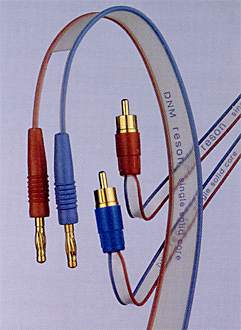
New photos of DNM Ribbon Cables here (in a new window).
The DNM stereo ribbon is dimensioned for the application and it contains four conductors that carry two channels
for stereo or one bi-wire channel. The ribbon is a key element because it controls the all-important spacing between
the conductors defining the RCL balance (resistance, capacitance and inductance) which determines the
ultra-high frequency loading - a factor that definitely affects the sound quality of the driving amplifier.
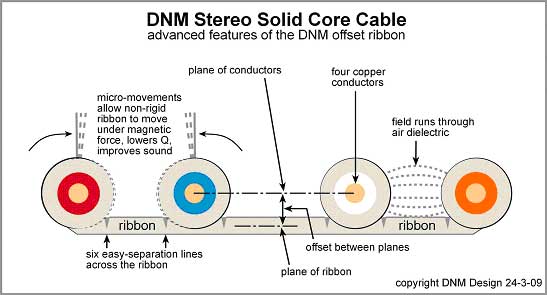
The DNM conductors are encased in a semi-transparent outer ribbon. The ribbon has an offset between its own plane and the
plane of the conductors, as shown above. This causes air to be the primary dielectric, reducing the capacitance between
the conductors and increasing linearity. Carefully selected spacing between the conductors minimises the high frequency
reflections that can reduce the performance of the amplifier.
An easy-separation feature is designed into the ribbon which has the added advantage of reducing its tendency to resonate
when the speaker current causes the conductors to be magnetically pulled together (reducing the Q of the structure).
The combined effect of all the advanced features in DNM Stereo Solid Core cables offer a new level of sound clarity at a modest price.
The three versions of DNM stereo cable are illustrated in detail
here
to compare their cross-section size, the drawing also shows dimensions and full technical information.
Full cable preparation and assembly instructions
here - extremely thorough, with helpful photos.
Original Mono Solid Core Cable
Since the early 1980's, there has been an increasing demand for
high-quality interconnect and speaker
cables. What began as a quest by music lovers to get that little bit more
out of their hi-fi systems has
grown into a multi-million pound business, full of marketing hyperbole,
exotic packaging and enough expensive metal to build a ship!
 Unfortunately,
many of these over-engineered cables owe more to
increasing the perceived value of the product than to improving sound quality.
Ribbon-type solid core cable was originally developed by
DNM back in 1984 and now has many converts. It
represents the opposite approach to most of the audiophile cable market, but it is designed for
domestic audio - and for that application we believe it is the best at any price. Unfortunately,
many of these over-engineered cables owe more to
increasing the perceived value of the product than to improving sound quality.
Ribbon-type solid core cable was originally developed by
DNM back in 1984 and now has many converts. It
represents the opposite approach to most of the audiophile cable market, but it is designed for
domestic audio - and for that application we believe it is the best at any price.
The majority of cables used in audio have been
selected for their low inductance, low resistance and high capacitance characteristics as
measured on the test bench. These parameters define what are
believed to be the electrical properties most ideal in an audio cable.
Applications, however, vary widely, from
recording studios through public address systems and live concert
amplification to the domestic, with each having its own particular
demands. No multi-purpose cable can suit the precise
requirements of the domestic music lover as well as one designed specifically
for that purpose - as home listening tests prove!
There are good technical reasons for this.
| |